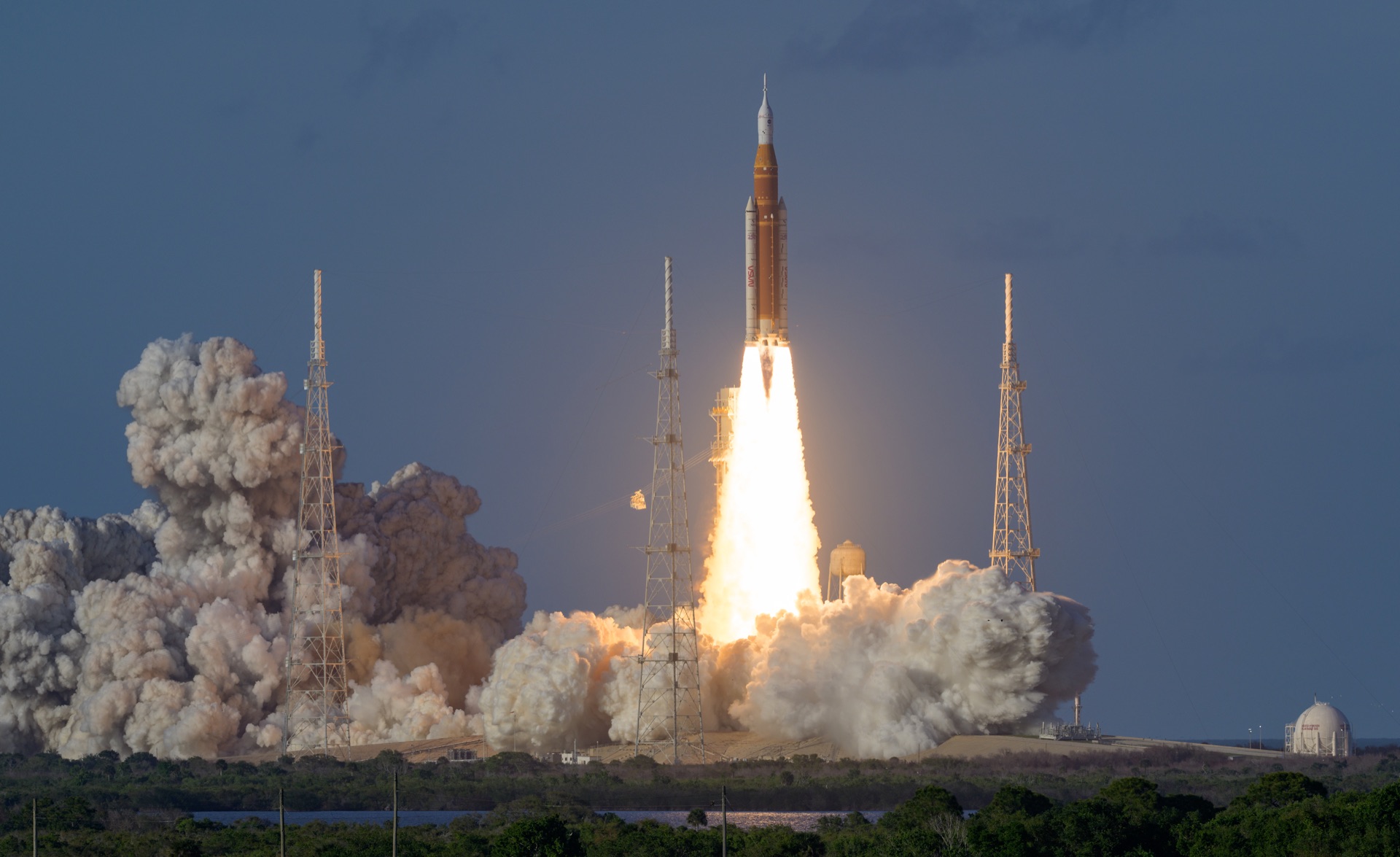
Artemis II Mission Status
PRE-LAUNCH
Countdown to launch is active.
Pre-launch preparations
View full schedule →Live Data
-
Speed
How fast Orion is moving relative to Earth. After the trans-lunar injection burn, the spacecraft coasts at roughly 39,000 km/h but gradually decelerates as Earth’s gravity pulls it back. It will speed up again during the lunar flyby as the Moon’s gravity slings the capsule around the far side.
- Awaiting data
-
Distance from Earth
The straight-line distance between Orion and Earth’s surface. During the outbound leg this number climbs steadily for about four days, peaking near 380,000 km. On Artemis II this makes the crew the farthest humans from home since Apollo 17 in 1972 — and the first to travel this far in over fifty years.
- Awaiting data
-
Distance from Moon
How far Orion is from the lunar surface. This shrinks dramatically during the flyby. At closest approach the crew will pass roughly 6,600 km above the far side — close enough to see individual craters with the naked eye, and far beyond the reach of any communication relay, producing several minutes of planned loss-of-signal.
- Awaiting data
-
Altitude
Orion’s height above the nearest major body (Earth near launch and return, the Moon during the flyby). Watch it drop quickly after launch as the spacecraft transitions from its parking orbit, then climb again on the trans-lunar coast. During the powered flyby it plunges back down before climbing once more on the return leg.
- Awaiting data
-
Signal Delay
The time it takes a radio signal to travel between Orion and Mission Control in Houston. Near Earth it’s negligible, but at lunar distance it reaches about 1.3 seconds each way. That means every voice call has a 2.6-second round-trip lag — noticeable in conversation, and a real factor when the crew needs to coordinate time-critical manoeuvres with the ground.
- Awaiting data
-
Range Rate
Whether the distance between Orion and Earth is growing or shrinking, and how fast. A positive value means the spacecraft is moving away; negative means it’s heading home. This is one of the key numbers flight dynamics officers watch to confirm the spacecraft is on the right trajectory after each burn.
- Awaiting data
-
Solar Phase Angle
The angle between the Sun, Orion, and the observer (Earth). It determines how much of the spacecraft is sunlit as seen from home. At 0° the Sun is behind the observer and Orion is fully lit; at 180° it’s backlit. This matters for optical tracking, thermal management, and tells you whether the crew is seeing a sunlit or shadowed lunar surface during their flyby.
- Awaiting data
-
Crew G-Force (estimated)
The acceleration the crew feels, expressed as multiples of Earth’s gravity. During coast phases it hovers near zero — the crew floats weightless. At launch it peaks around 2.5 G (the crew weighs 2½ times normal), and during re-entry it surges to roughly 4 G for several minutes as the capsule decelerates through the atmosphere. That’s uncomfortable but well within the crew’s training limits.
- 1.0 G
- Normal Earth gravity
-
Earth View
The region of Earth directly below Orion right now — the sub-spacecraft point. From the crew’s distance, they can see an entire hemisphere at once: oceans, continents, cloud patterns, and the thin blue line of the atmosphere. As Orion travels farther from Earth, more of the planet fits in their window, but individual features grow smaller. This is computed from Orion’s geocentric position vectors provided by JPL Horizons.
- Awaiting data
-
Earth Apparent Size
How large Earth appears to the crew, measured as an angular diameter in degrees. On Earth, the Moon looks about 0.5° across — roughly a pinky fingernail at arm’s length. As Orion travels toward the Moon, Earth shrinks from filling the windows to a small, brilliant disc. The crew can literally watch their home world become a dot, giving them the “Overview Effect” — a profound shift in perspective reported by nearly every deep-space astronaut.
- Awaiting data
-
Moon Apparent Size
How large the Moon appears to the crew, measured as an angular diameter in degrees. From Earth, the Moon spans about 0.5°. During the outbound coast the Moon grows slowly larger; during the close flyby it swells dramatically — potentially filling an entire window. At closest approach (~6,600 km) it can appear over 29° wide, roughly the span of a hand with fingers spread apart. This is a view no human has seen since the Apollo era.
- Awaiting data
Data shown is estimated based on mission trajectory. Live NASA telemetry is not yet available.
Space Weather
-
Overall Risk Level
A combined assessment of solar flares, geomagnetic storms, coronal mass ejections, and solar energetic particle events over the last 3 days. For Artemis II crew travelling beyond Earth’s magnetosphere, “Elevated” means conditions should be monitored and “Severe” may require sheltering inside Orion’s crew module or adjusting the flight plan.
- Loading…
-
Last Solar Flare
Solar flares are bursts of radiation from the Sun, classified by intensity: C-class are common and weak, M-class are moderate and can cause brief radio blackouts, and X-class are the most powerful — they can disrupt communications and, critically for a deep-space crew, produce dangerous radiation. For Artemis II astronauts beyond Earth’s magnetic shield, an X-class flare could require sheltering inside Orion’s crew module.
- Awaiting data
-
Recent flares
-
Geomagnetic Storms
Geomagnetic storms happen when a burst of solar wind hits Earth’s magnetic field, measured on the Kp index (0–9). Kp 5+ means a storm is underway: satellite electronics can glitch, GPS accuracy drops, and at Kp 7+ high-frequency radio goes down. For Artemis II, storms shake up the radiation belts the crew passes through during launch and re-entry. A strong storm can also affect Deep Space Network tracking and communication.
- Awaiting data
-
Storm history
-
Crew Radiation
Solar energetic particle (SEP) events are the biggest radiation threat to astronauts. When a powerful flare or CME accelerates protons to near light speed, they can penetrate spacecraft walls and cause radiation sickness. On the ISS, Earth’s magnetosphere provides shielding. Artemis II will be beyond that shield for most of the mission. If an SEP event is active, the crew would shelter in the most shielded part of the Orion capsule and mission controllers may adjust the flight plan.
- Awaiting data
-
SEP event details
-
CMEs
A coronal mass ejection (CME) is a massive cloud of magnetised plasma hurled from the Sun. It travels at 250–3,000 km/s and can take 1–3 days to reach Earth. If directed at Earth or the Moon, a CME can trigger geomagnetic storms, radiation spikes, and communication disruptions. For Artemis II, an inbound CME is the main reason mission controllers might modify the flight timeline — it’s the “space hurricane” that the crew and ground teams watch for most closely.
- Awaiting data
-
Recent CMEs
Data from NASA DONKI (opens in new tab). Updated every 15 min.
Checking communications status…
Deep Space Network Tracking
DSN data loading…
Data from NASA DSN Now. Updated every 60 seconds.
Audio Radar
Audio Radar
Sonification of spacecraft positions. A radar sweep scans left to right; objects ping at their stereo position as the sweep passes.
How Audio Radar Works
The Audio Radar represents spacecraft positions as spatial sound. Headphones are recommended for accurate stereo positioning.
How the sweep works
A radar sweep pans from left to right every few seconds. Each object produces a distinct sound at its stereo position as the sweep passes. Earth is fixed on the left channel and the Moon on the right, establishing a consistent spatial frame of reference.
Three views, one journey
The radar selects a view automatically based on Orion's position, though manual selection is also available.
- Earth Orbit — Near-Earth space, with Earth on the left and the ISS and orbital landmarks distributed across the stereo field. Active when Orion is within 100,000 km of Earth.
- Earth–Moon Transit — The full cislunar corridor. Earth on the left, Moon on the right. Active during the coast phase between the two bodies.
- Moon Orbit — The lunar vicinity, with the Moon at centre and Orion orbiting around it. Active when Orion is within 50,000 km of the Moon.
Sound guide
Each object is assigned a distinctive sound signature for immediate identification.
- Earth — Three rising notes, reminiscent of birdsong
- Moon — A resonant, singing-bowl tone
- Orion — A Quindar-style tracking beep
- ISS — A short ascending frequency sweep
- Sweep — A soft noise hiss that pans across the stereo field, marking the sweep position
Tips
- Stereo position corresponds to spatial location. Left indicates proximity to Earth; right, to the Moon.
- Orion's pitch varies with velocity — higher pitch indicates greater speed.
- Signal attenuation occurs when Orion passes behind the Moon, reflecting the real loss-of-signal experienced during far-side transit.
Audio disabled
Live Coverage
24/7 mission coverage with mission control audio and crew communications.
Open in YouTube